
The Climate Time Machine
Understanding the climate. Simulating decisions. Change the future.
A digital serious game for companies, organizations and municipalities
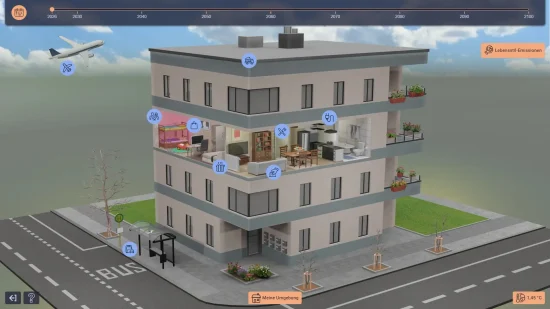
The Climate Time Machine creates a space in which complex interrelationships are not explained, but experienced. Make virtual decisions—and see how they affect emissions and future scenarios, in real time.
You will be redirected to
an Outlook booking page.
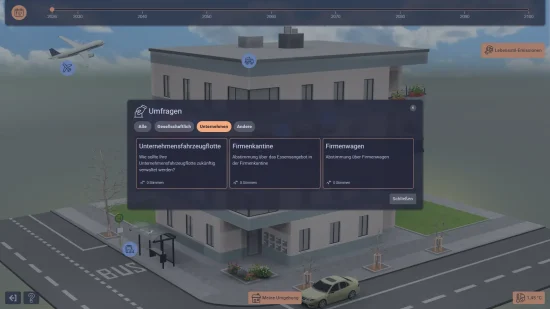
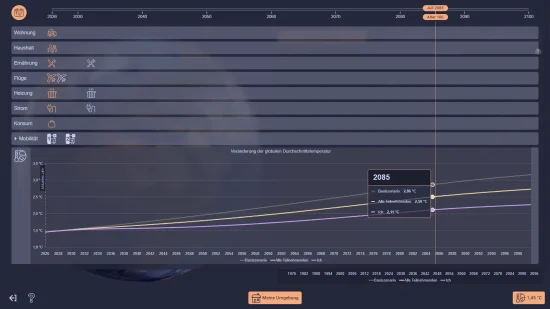
A completely new approach to climate data
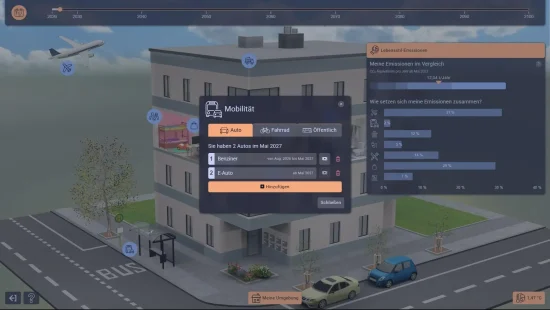
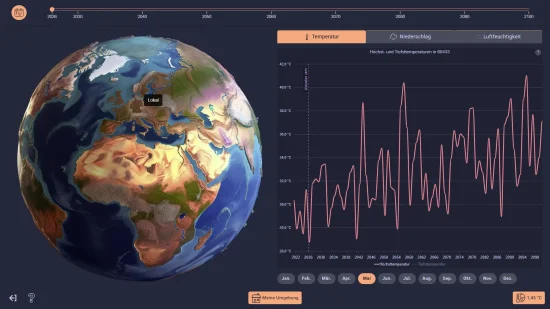
Many climate tools provide figures – the Climate Time Machine creates understanding from them. It is not a simple emissions calculator. It translates real decisions into concrete climate consequences. The abstract global warming becomes consequences that affect the participants – because the Climate Time Machine reflects them in the realities of their individual lives. In peak summer temperatures, in visibly suffering vegetation, in extreme weather events. Climate change has never been so tangible.
Time travel instead of
columns of numbers
The Climate Time Machine focuses on concrete climate impacts that unfold along a comprehensible future.
Experience instead of
instruction
Those who acquire knowledge and connections themselves understand better and faster. In the Climate Time Machine, knowledge comes from experience.
Your own reality instead of standard scenarios
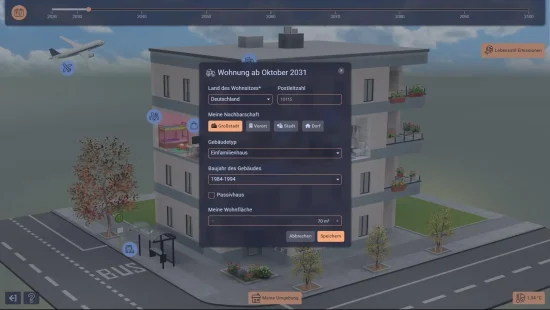
The Climate Time Machine works with specific inputs instead of generalized average values. The simulation is based on individual, real contexts.
Common orientation in complex contexts

The Climate Time Machine is designed for shared use. It is often used in groups – for example in workshops, learning settings or dialog formats. However, it can also be used independently.
The focus is on a shared view of interrelationships: decisions, assumptions and their effects become visible and comprehensible for everyone. This creates a common basis for conversations, discussions and further decisions.
Whether used in an accompanied or self-organized way – the Climate Time Machine helps to jointly understand and classify complex climate dynamics.
Fields of application: Wherever climate knowledge is required
The Climate Time Machine helps you to jointly understand climate impact from the perspective of individual lifestyles in a wide variety of contexts. Depending on the environment, you can achieve different goals.
-
Companies and organizations
As a common basis for exchange, awareness-raising and motivation for climate-friendly decisions in a professional context. Use the CTM as a communication tool to convince stakeholders.
-
Municipalities and public institutions
As a connecting point of reference for dialog with different backgrounds and perspectives. Support your climate protection measures with the CTM. -
Education and training
As a low-threshold introduction to exploring and jointly reflecting on climate issues from your own everyday life. Teach the basics of climate protection with the CTM.
Scientifically sound and transparent
The Climate Time Machine is based on established climate models and recognized data sources. It translates scientific findings into tangible futures.
The calculation of individual emission values is mainly based on emission factors from the German Federal Environment Agency (UBA). In addition, other established sources are used, including specialist literature and authorities such as the US Environmental Protection Agency (EPA), particularly in special areas such as heating energy.
Sources:
- UBA: https://www.umweltbundesamt.de/themen/klima-energie/klimaschutz/treibhausgas-emissionen
- US EPA: https://www.epa.gov/climateleadership/ghg-emission-factors-hub
The Climate Time Machine uses the Hector climate model, a widely used model in climate research for rapid simulations of global climate paths. It reproduces the results of complex climate models in a comprehensible way and is used by the Potsdam Institute for Climate Impact Research (PIK), among others. A business-as-usual scenario from the IPCC (RCP 6.0) serves as the starting point, providing a realistic reference for the development of emissions and climate impacts.
Sources:
- Hector Climate Model (JGCRI): https://jgcri.shinyapps.io/HectorUI/
- IPCC Representative Concentration Pathways (RCPs): https://www.ipcc-data.org
Regional climate values and climate impacts are based on the international ISIMIP database. In ISIMIP, research teams worldwide pool their simulations of climate impacts with high spatial and temporal resolution, based on various established climate models and emission scenarios.
For the sea level rise, a model provided by PIK is used, which was the basis for a publication in PNAS, among others.
Sources:
- ISIMIP – Inter-Sectoral Impact Model Intercomparison Project: https://www.isimip.org/
- Kopp et al. (PNAS, sea level model): https://www.pnas.org/doi/10.1073/pnas.1500515113
The Climate Time Machine derives global emission paths from individual and group-related emission values. The extrapolation logic used for this is an in-house development by SCIARA, created with technical support from PIK.
The resulting future scenarios are not predictions, but scientifically based statements of probability. They serve to make connections comprehensible and provide orientation for discussions and classification.
The calculation of individual emission values is mainly based on emission factors from the German Federal Environment Agency (UBA). In addition, other established sources are used, including specialist literature and authorities such as the US Environmental Protection Agency (EPA), particularly in special areas such as heating energy.
Sources:
- UBA: https://www.umweltbundesamt.de/themen/klima-energie/klimaschutz/treibhausgas-emissionen
- US EPA: https://www.epa.gov/climateleadership/ghg-emission-factors-hub
The Climate Time Machine uses the Hector climate model, a model widely used in climate research for rapid simulations of global climate paths. It reproduces the results of complex climate models in a comprehensible way and is used by the Potsdam Institute for Climate Impact Research (PIK), among others. A business-as-usual scenario from the IPCC (RCP 6.0) serves as the starting point, providing a realistic reference for the development of emissions and climate impacts.
Sources:
- Hector Climate Model (JGCRI): https://jgcri.shinyapps.io/HectorUI/
- IPCC Representative Concentration Pathways (RCPs): https://www.ipcc-data.org
Regional climate values and climate impacts are based on the international ISIMIP database. In ISIMIP, research teams worldwide pool their simulations of climate impacts with high spatial and temporal resolution, based on various established climate models and emission scenarios.
For the sea level rise, a model provided by PIK is used, which was the basis for a publication in PNAS, among others.
Sources:
- ISIMIP – Inter-Sectoral Impact Model Intercomparison Project: https://www.isimip.org/
- Kopp et al. (PNAS, sea level model): https://www.pnas.org/doi/10.1073/pnas.1500515113
The Climate Time Machine derives global emission paths from individual and group-related emission values. The extrapolation logic used for this is an in-house development by SCIARA, created with technical support from PIK.
The resulting future scenarios are not predictions, but scientifically based statements of probability. They serve to make connections comprehensible and provide orientation for discussions and classification.
How to use the Climate Time Machine:
Open Climate Time Travel
Public workshops for individuals and mixed groups to get to know the Climate Time Machine and gain initial experience.
Climate Time Travel for companies
Moderated formats for existing groups in companies and other organizations – individually tailored.
Events & special formats
Use the Climate Time Machine as part of events, conferences or action days to make climate impact tangible in a low-threshold way.
